


Occupancy Rate is the Heartbeat of Your Short-Term Rental

Updated: Apr 10
Your Airbnb occupancy rate is like the pulse of your short-term rental business. It shows how frequently your property gets booked, which has a direct effect on your income, your profitability, and your taxes.
Understanding this vital metric can make all the difference between a host who struggles and one who sees great returns.

Whether you're managing one listing or building a portfolio short-term rentals, occupancy optimization can transform your results.
What Is Airbnb Occupancy Rate?
Your Airbnb occupancy rate measures the percentage of available nights your property is actually booked during a specific period.
Example: If your listing was available for 30 nights and booked for 24 nights, your occupancy rate is 80%.
Formula: (Booked Nights ÷ Available Nights) × 100 = Occupancy Rate %
This metric provides insight into your property's market performance, helps you identify seasonal trends, and allows you to benchmark against competitors using Airbnb data from your market.
What's Considered a Good Occupancy Rate?
Occupancy rates fluctuate based on location, property type, seasonality, and your Airbnb pricing strategy. Here are a few typical benchmarks:
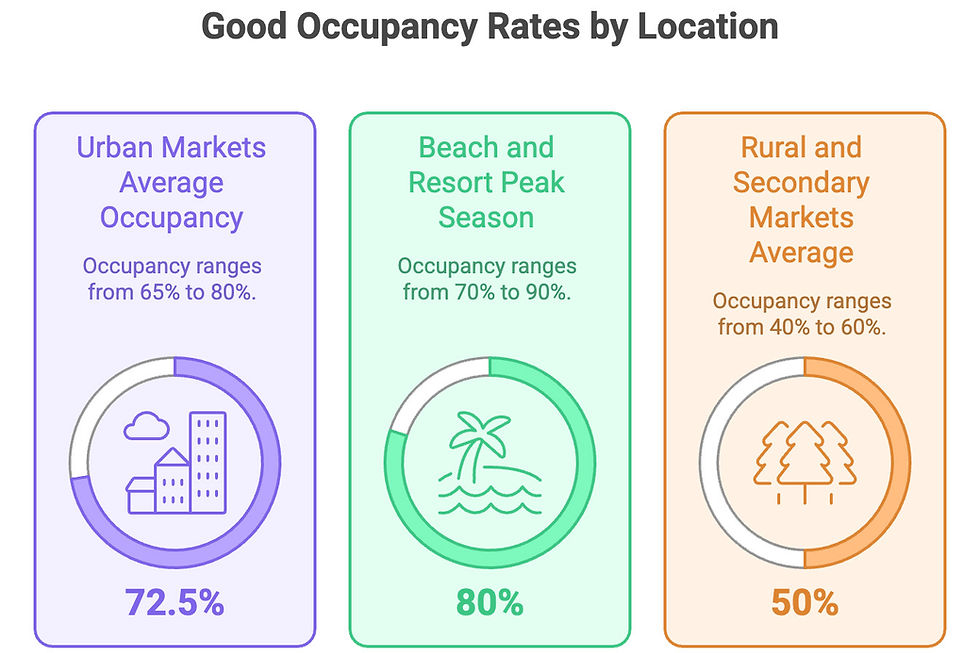
While a rate above 70% is generally strong, remember that profitability isn't just about occupancy. A property at 65% occupancy with premium pricing may outperform one at 85% with discounted rates.
The sweet spot balances high occupancy with optimal nightly rates.
5 Factors Influencing Your Airbnb Occupancy Rate
Airbnb Pricing Strategy
Pricing too high scares away bookings; pricing too low leaves money on the table. Dynamic pricing tools like PriceLabs, Beyond Pricing, or Wheelhouse automatically adjust your rates based on real-time Airbnb data including local demand, competitor pricing, and upcoming events.
Seasonality & Market Trends
Every market has peak and off-peak periods. Successful hosts anticipate these cycles and adjust accordingly, raising rates during high demand and offering strategic discounts during slower months to maintain steady bookings.
Location & Amenities
Proximity to attractions, public transportation, restaurants, and business districts drives bookings. Amenities like fast Wi-Fi, dedicated workspace, parking, and thoughtful touches (quality coffee, smart TV, comfortable bedding) significantly impact guest decisions.
Listing Optimization
Your listing is your storefront. Professional photography, compelling descriptions, and titles that highlight unique features improve visibility in Airbnb's search algorithm. An optimized listing can increase click-through rates by 40% or more.
Reviews & Responsiveness
Positive reviews build credibility and boost your search ranking. Responding quickly to inquiries (ideally within an hour) and maintaining consistent 5-star experiences creates momentum that helps increase online bookings organically.
Balancing Occupancy Rate with Overall Profitability
High occupancy alone doesn't guarantee success. Consider this example:
Property A:
85% occupancy at $100/night = $2,550 month revenue
Property B:
70% occupancy at $140/night = $2,940 month revenue
Property B earns 15% more revenue despite lower occupancy because of strategic pricing. Always calculate your Revenue Per Available Night (RevPAN) alongside occupancy rates to understand true performance.
Checklist to Increase Airbnb Bookings & Boost Occupancy
☐ Perfect Your Listing Title and Photography
Your title should immediately communicate value: "Modern Downtown Loft with Skyline Views & Free Parking" beats "Nice Apartment." Invest in professional photography, it's one of the highest-ROI improvements you can make.
☐ Implement Dynamic Pricing
Manual pricing can't keep pace with market fluctuations. Dynamic pricing tools analyze Airbnb data across your market and adjust rates automatically based on demand, seasonality, local events, and competitor activity. This is one of the fastest paths to occupancy optimization.
☐ Offer Strategic Discounts
Weekly and monthly discounts attract longer stays, which reduce turnover costs, cleaning frequency, and vacancy gaps. Many hosts find that offering 15-20% discounts for extended stays actually increases total revenue.
☐ Maintain an Active Presence
Airbnb's algorithm rewards active hosts. Update your calendar regularly, respond promptly to messages, and adjust your availability based on upcoming events or local trends. Hosts who engage daily typically see 10-15% higher occupancy rates.
☐ Deliver Exceptional Guest Experiences
Small details create big results: clear check-in instructions, welcome baskets, local recommendations, and quick problem resolution. Happy guests leave glowing reviews, book return visits, and become your best marketing channel.
☐ Leverage Last-Minute Booking Opportunities
Enable Instant Book for last-minute reservations and consider offering discounted rates for same-week bookings. This fills calendar gaps that would otherwise remain empty.
Tracking Your Performance with Data
Monitor your Airbnb occupancy rate through your host dashboard, but for deeper insights, consider analytics platforms like:
AirDNA: Market-level data and competitive analysis
PriceLabs or Wheelhouse: Dynamic pricing with performance tracking
AllTheRooms Analytics: Multi-market portfolio analysis
Compare your performance against local averages monthly. Look for patterns:
Which months underperform?
What price points maximize revenue?
How do advance reservations affect your occupancy?
How do last-minute bookings affect your occupancy?
Occupancy optimization is an ongoing process. Adjust your strategy quarterly based on performance data, guest feedback, and market conditions.

Why Your Occupancy Rate Matters for Your Taxes (Not Just Your Revenue)
Most Airbnb hosts track occupancy rate for one reason: revenue. More booked nights means more cash coming in. But if you stop there, you're missing half the picture. Your occupancy rate has a direct line to your tax strategy, and for investors who use bonus depreciation and cost segregation, it can make the difference between unlocking tens of thousands in tax savings or leaving that money on the table.
Here's how the two connect.
Higher Occupancy = Higher Income = Bigger Tax Savings Opportunity
The whole point of cost segregation and bonus depreciation is to offset taxable income. A property running at 80% occupancy generates dramatically more taxable income than one running at 50%, which means there's more income for your accelerated depreciation deductions to shelter.
Let's say your Airbnb nets $15,000 in taxable income, a cost segregation study that generates $80,000 in Year 1 deductions creates a large suspended loss you may not be able to use right away. But if that same property is running at higher occupancy and nets $60,000 in taxable income, you can actually deploy a much bigger chunk of those deductions against active income in the year you take them.
Occupancy optimization isn't just about growing the top line. It's about creating the taxable income your depreciation strategy needs to work against.
Occupancy Data Helps Prove the STR Loophole
The short-term rental tax loophole is one of the most powerful tax tools available to Airbnb investors. It lets you use rental losses (including the large paper losses from bonus depreciation) to offset active income like your W-2 salary. But to qualify, you have to prove two things:
Your average guest stay is 7 days or less
You materially participate in the business
This is where your occupancy data becomes tax documentation. High occupancy with short stays is the ideal profile for STR loophole qualification, and it also happens to be the most tax-advantaged setup for depreciation deductions.
High Occupancy Makes Material Participation Easier
Even if you clear the 7-day average test, you still need to materially participate to unlock the STR loophole. The most common path is the 100-hour test: you spend more than 100 hours on the rental during the year, and no one else (cleaner, co-host, property manager) spends more hours than you.
Higher occupancy naturally generates more documented hours, which makes it easier to clear the material participation threshold without feeling like you're padding a time log. Your occupancy rate is a leading indicator of whether you can credibly claim material participation if the IRS comes asking.
Making Your Airbnb Occupancy Rate Work for You
Your Airbnb occupancy rate is a metric that reveals how well your property competes in the market. Combine it with smart pricing, compelling listings, and exceptional hospitality. Then you've laid the foundation for building a profitable business as a Real Estate Professional.
Every point of occupancy increases the income your deductions can offset, strengthens your case for the STR loophole, generates the management hours that prove material participation, and improves the ROI on a cost segregation study.
Track your Airbnb data, test new strategies, learn from results, and refine your approach.
The hosts who consistently increase STR bookings are those who view their properties as hospitality businesses deserving strategic attention.
Track your occupancy rate like a revenue metric. Then manage it like a tax metric.


Comments